Welcome to the Birkin Flares/Kendall Skinnies sew-along! I am so glad you've decided to sew your own jeans. I can tell you with 100% honesty that I love my handmade jeans more than any other jeans I've owned. I find the process to be extremely enjoyable, and the end result is something you can wear with a big smile on your face.
There's a misconception that jeans are hard to make. Really - t's totally false! There are really only three parts that are challenging in my opinion: 1) finding the supplies, 2) getting the right fit and 3) perfecting your topstitching. Lucky for us, there are tons of options for supplies nowadays (which I'll share in this post), dozens of tutorials and books on fit and...well...all I can say about perfect topstitching is that practice makes perfect! (And I'll give you a lot of tips along the way!)
So, are you ready to get started? Let's dig in and talk fabric and supplies!
For the Birkin Flares, you're going to need 2.5-3 yards of medium- to heavyweight stretch woven fabric. (See your pattern for exact amounts.) This includes the following:
- Denim
- Velveteen
- Corduroy
- Twill
Some of my testers were able to get away with about 2.25 yards of fabric, but they were using unusually wide fabric. Be aware that keeping your pattern on-grain is super important for these jeans, so don't fall into the temptation of angling your pattern pieces when cutting to get your jeans out of less fabric!
I find that 10-12oz denim with around 2% lycra/elastane/spandex works best - it has the best combination of stretch and recovery. A lighter-weight denim will yield a dressier-looking jean, and I suggest creating a deeper hem with lighter weights to weigh the jeans legs down. I also like denim with a little polyester or rayon content, and you'll find this in many of the higher-end, designer jeans.
Note that the lycra/elastane/spandex content percentage does NOT translate to the percentage of stretch. Percentage stretch is a ratio of the measurement of the stretched fabric to the non-stretched fabric. With the types of fabric you'll be using for your jeans, you'll usually hear it expressed as a percentage of content rather than stretch.
For the Kendall Skinnies, you will need about 1.5 - 2 yards of the same types of fabric, however, you can potentially use a lighter-weight (as low as 7-9oz) with success. You also want to be absolutely sure that it has a decent amount of stretch (don't skimp and get a 1%-lycra-content fabric!) since they are very fitted all the way down to the ankle. Your knees will not be happy with a lower amount of stretch!
If you've been thinking about using non-stretch fabric, I don't recommend it for either of my jeans patterns. They actually have negative ease at the hips to achieve a nice, sleek (yet forgiving!) fit, and the waist is designed to stretch with you for maximum comfort (without stretching out).
Here are my favorite sources for high-quality denim:
- Threadbare Fabrics (sells several weights/colors of stretch and S-Gene Cone Mills denim)
- Fancy Tiger Crafts (sells Cone Mills, but not S-Gene, denim)
- Indiesew (sometimes sells very nice, heavyweight stretch denim and is looking to stock a muslin-quality denim, too - just head to their site and search "denim")
Designer-quality denim will run you about $12-16/yard. I've used cheaper denims with some success, but I find that they "bag out" at the knees and bottom after a few hours of wear. The higher end denims hold their shape and don't wrinkle as badly, in my opinion. I have randomly found decent denim in the red-tag section at Joann Fabrics, so definitely check there - especially if you want to make a muslin first.
Rivets, Buttons, Zippers & Topstitching Thread
I get all my jeans hardware (buttons, rivets and zippers) from TaylorTailor. He also sells high-quality topstitching thread in several shades. I have found that Coats & Clark topstitching thread works best on my machine as it is a little thinner and smoother than others. I like the LOOK of the thicker thread, but my sewing machine tends to shred it even using a topstitching needle.
If you are going for a high-contrast look, use lighter-colored topstitching thread. If you want a more classic, understated look, choose a darker copper color. For a tone-on-tone look (great for dressier jeans in dark indigo), you can use navy topstitching thread. Of course, you can also have a lot of fun and choose a fun pastel or bright spool!
Don't be afraid of hammer-in buttons and rivets. I actually find them to be the easiest to install, and I have a handy video in the finishing section to show you exactly how to do it. Don't worry!
Finally, you can get away with a 5" zipper for the smaller sizes, but I always buy 7" zippers out of habit and just to be safe. It's really easy to cut them down to the perfect length when you get to that stage.
Other Supplies
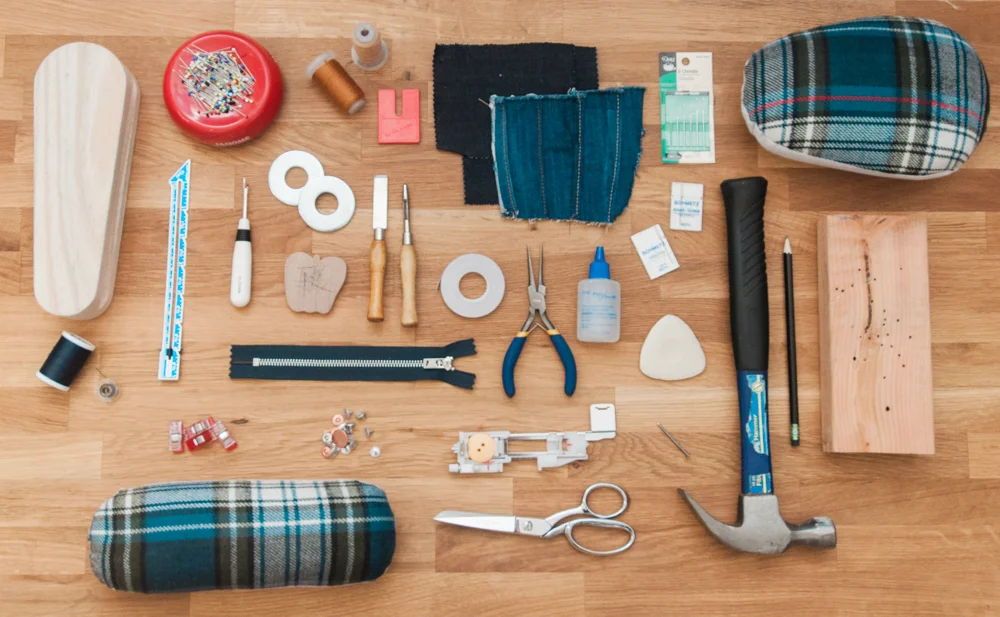
A list of other supplies you will/might need is included in your pattern. However, there are a couple that I want to highlight as I find them vital to successful jeans making.
First is a topstitching needle (or a few!). I do ALL the stitching on my jeans with one of these regardless of whether I'm using topstitching thread. The difference is that they have a larger thread eye, so they don't shred the thicker thread. I usually use a size 12 or 14 as I've never seen them in a size bigger than that. I always have success finding these at chain or independent fabric stores.
Side note: Always use regular thread in your bobbin. Never put topstitching thread in there! Just load your bobbin with some thread that matches your fabric (navy for denim, as an example), and don't change it when you change the top thread. As for serger thread, I use three spools of gold serger thread for all my jeans. You can use what you like as it will only ever show if you cuff the ankles of your jeans.
If using a heavier-weight fabric, I also find a hammer to be crucial. (You'll need one if you're using hammer-in rivets and buttons, too.) You use it to hammer thick seams and make them easier to sew on the machine. You can buy one of these at any hardware or big-box store. And while you're there, pick up some needle-nose pliers to pull off excess zipper teeth.
A triangular tailor's chalk is a godsend for me in jeans making. I find it leaves the best mark and comes off super easily. I use white for pretty much everything. You can purchase these at any fabric store.
A few pressing tools will also come in handy. I use a tailor's clapper, a sleeve sausage (for the legs) and a ham (for curved seams) in constructing almost all woven garments. You will find them handy for jeans as well as many other applications. You can stock up on these at Joann when they are offering great coupons (or click on the links to purchase via Amazon).
There are lots of other supplies I recommend in the pattern, but those are a few of the ones I consider to be vital to your success. If you have any questions, be sure to ask in the Baste + Gather Sewing Chat group on Facebook or in the comments below! I will do my best to answer.
Once you've got your fabric and other supplies, let's get sewing!